The deficit between asylum legal aid need and provision in England and Wales now stands at 52%, taking into account both applications and appeals. Fewer than half of all ‘instances of need’ by main applicants or appellants will be met.
Although some data is still unavailable, because of the Legal Aid Agency’s 2025 data breach, it’s now possible to assess the scale of the asylum legal aid deficit for the year to 31 March 2026.
It breaks down like this:
There were 76,714 applications for asylum in the UK (excluding dependants) in the year to March 2026.
There were 63,629 asylum, protection and revocation appeals received in the FTT in the year to March 2026.
That makes a total of 140,343 ‘instances of need’ for legal representation. Of these, 91% are accommodated in England and Wales. The vast majority of people seeking asylum will be financially eligible for legal aid.
This compares with legal aid provision of 61,070 ‘immigration-asylum’ cases on the Legal Help scheme (including Controlled Legal Representation) which applies to asylum applications and appeals. Non-asylum cases are separately counted as ‘immigration-other’.
That leaves a deficit of 66,642 instances of need - either application or appeal - for a main applicant, or 52% of the total need, going unrepresented on legal aid.
With the exception of London, every part of England and Wales has a deficit which is larger than its total provision figure. As in previous years, the data shows the largest deficit is in the North West of England. The West Midlands and South East show the next-largest shortages.
This probably underestimates the size of the deficit, because the data currently available relates to legal aid cases closed, not those opened. The data for new cases opened in the year to 31 March 2026 is not yet published (apparently because of the data breach). The case closure data reflects some cases opened when the previous government paused asylum processing, and closed after processing accelerated, with large numbers of decisions being made in 2025.
This exaggeration effect is likely to be largest for London, given the much larger number of provider offices based there, and may explain why it is the only area not currently showing a deficit. The data also include cases closed by at least one firm which opened large numbers of cases before having its legal aid contract withdrawn. Cases closed when a provider closes or surrenders its legal aid contract will appear as closed unless they are transferred to another provider.
The missing data also makes it impossible to assess the split of those legal aid cases between initial applications or appeals. Anecdotally, though, there is abundant evidence of applicants being dropped by legal aid providers when they receive a refusal from the Home Office, while other providers openly limit their appeals work. Public Law Project’s research suggests only a minority of providers are willing to take on appeals work.
Representation really matters: new data from the Immigration and Asylum Chamber of the First Tier Tribunal shows that only 26-35% of unrepresented appellants succeed on appeal.
That compares with 51-58% of represented appellants. Taking into account the number of represented and unrepresented appellants, the percentage point difference in success rates –the representation premium - rises to 32 percentage points in 2024-25.
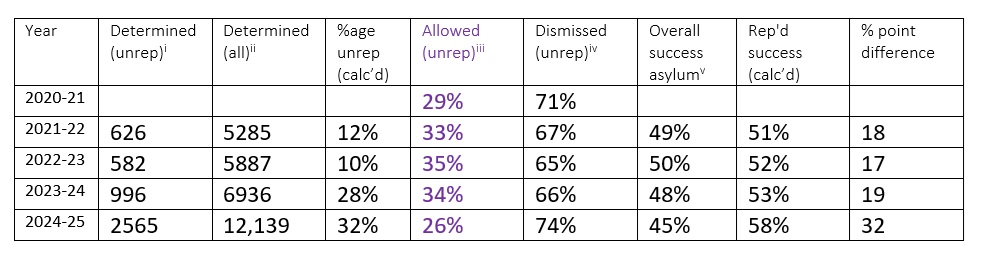
Other things being equal, one might explain at least some of that difference by assuming that lawyers filtered out weaker appeals and offered representation to those with a higher chance of success. Yet the size of the deficit here makes that explanation ineffective: a large proportion of appellants will never have had their case reviewed by a lawyer at all. It is much more likely, therefore, that the representation premium arises from the lawyer’s role in gathering evidence, ensuring the appellant gives a detailed witness statement, and pointing out the flaws in the Home Office decision – as suggested in research on the Windrush Compensation Scheme.
So, with some caveats around the missing data on legal aid provision, the evidence shows that more than half of instances of asylum legal aid need go unrepresented, and that lack of representation really matters to the accuracy and fairness of the process.
---
i From FOI response 251105040, 26/11/2025
ii From Tribunal Statistics Quarterly, table FIA_3
iii From FOI response 260120106 12/03/2026
iv From FOI response 260120106 12/03/2026
v From Tribunal Statistics Quarterly, table FIA_3