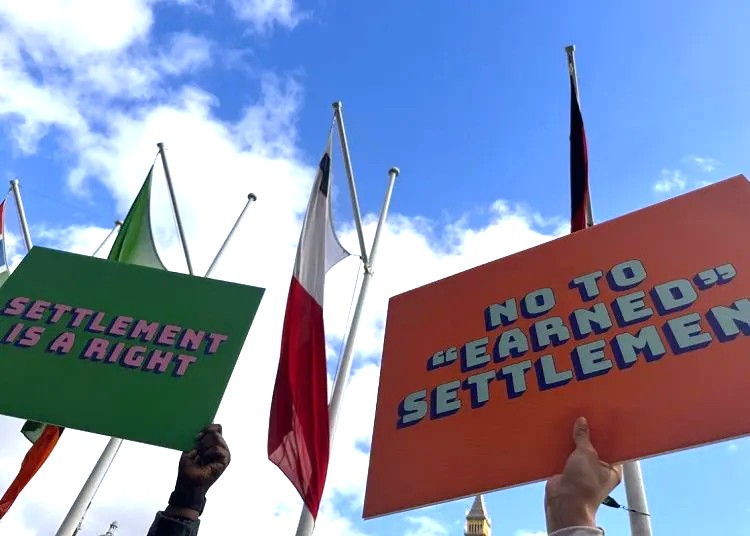
Step Change’s Experts by Experience group, GREAT!, works to influence asylum and refugee policy by drawing on members’ lived experience through collective responses to government proposals and direct engagement with decision makers. GREAT! has developed a statement in response to the government’s latest proposals on settlement and asylum. Building on this, the group attended the mass lobby at Parliament on 11th March 2026, where they shared their concerns directly with their MPs. Tamirat, a member of GREAT!, reflects on his experience below.
The day began bright and sunny. The warmth of the morning lifted our spirits as we prepared to leave for Westminster in London. On Wednesday, 11 March, we set off by coach from Piccadilly in the heart of Manchester. Around 50 of us travelled together, many with lived experience of the asylum and immigration system, along with volunteers and staff from organisations supporting refugees and asylum seekers across Greater Manchester.
A serious trip but we were singing
Although the reason for our trip was serious, the journey itself was full of life and energy. People from groups such as GREAT! (Greater Manchester Refugees and Asylum Seekers Together), RAS Voice (Refugees and Asylum Seekers Voice), These Walls Must Fall and Women Asylum Seekers Together filled the coach with conversations, music and laughter. Some began clapping and singing, and soon others joined in. At moments people even danced in the aisle. The mix of voices, cultures and experiences created a lively atmosphere that carried us through the long journey, reminding us that while we were travelling for an important cause, we were also sharing a moment of togetherness.
Our destination was Central Hall Westminster, where a mass lobby was taking place. A mass lobby is when large numbers of people go to Parliament to meet their Members of Parliament and speak directly about issues that matter to them. On this day, hundreds of people from across the UK gathered for the same purpose: to raise concerns about the government’s proposed “earned settlement” changes affecting migrants, refugees and asylum seekers.
The proposed changes to settling in the UK
In November 2025, the Home Secretary announced plans that would make it much harder for people to settle in the UK. The proposals would increase the usual qualifying period for settlement from five to ten years. In some cases it could even extend to 30 years, especially for people who have had to rely on public funds or who arrived on certain visas. The changes may also apply retrospectively to people who are already on a path to settlement. There are also concerns that the ‘No Recourse to Public Funds‘ condition could be expanded to many more non-citizens.
If implemented, these proposals could have serious consequences. Many families who already consider the UK their home could face many more years of uncertainty. It is estimated that more than one million people could be affected, including around 300,000 children. Campaigners warn that as many as 90,000 children could be pushed into poverty. In Greater Manchester alone, it is estimated that one in ten residents might be affected. Critics also fear the changes could harm integration, place pressure on sectors such as the NHS and social care, and create further insecurity for many workers and families.
Meeting other protestors and our MPs
When we arrived in Westminster, we joined hundreds of others who had travelled from different parts of the country. The atmosphere was energetic but focused. People gathered in the lobby areas, waiting for their scheduled meetings with MPs. Some met their MPs in groups; others, including me, had individual meetings.
During these meetings we shared our experiences and concerns. We urged MPs to write to the Home Secretary and ask for the proposals to be halted because of the serious concerns raised by constituents. We also asked them to push for a full impact assessment and proper parliamentary scrutiny before any changes move forward. Another key request was that any changes should not be applied retrospectively to people already living and building their lives in the UK. In the longer term, we asked the government to work with affected communities to build a fair and realistic pathway to settlement, with a clear limit of five years.
For me personally, the day had special meaning. As a refugee myself, meeting my own MP and speaking directly about these issues was a powerful experience. Migration is often discussed as a political topic, but behind the policies are real people, families and children whose lives are deeply affected by these decisions.
A visit to Westminster and the Houses of Parliament
After my meeting, I had the chance to visit the Palace of Westminster, where the House of Commons and the House of Lords are located. It was my first time inside the historic building, and I felt a sense of awe walking through its grand halls. My MP kindly arranged gallery tickets so I could watch the debates in person. From the public gallery I observed proceedings in both chambers. In the Commons, MPs were debating the Finance(No. 2) Bill, while in the Lords members were discussing the Crime and Policing Bill. Seeing the discussions live gave me a deeper understanding of how decisions are made.
Later in the day, we gathered again on the bus with our groups before beginning our long journey back. The round trip took around nine hours on the road, and by the time we returned to Manchester we were all exhausted. Yet despite the tiredness, there was a strong feeling that the day had been worthwhile.
Tired but encouraged at the end of the day
The trip reminded us of our shared strength and resilience. Many of us have faced hardship and uncertainty, but coming together in solidarity gave us hope. Change may not happen overnight, but raising our voices and speaking directly to lawmakers is an important step. We returned to Manchester tired but encouraged, carrying with us a renewed sense of determination, unity and hope for the future.
Read the full statement from GREAT! regarding the settlement and asylum proposals
(Image: Asylum Matters)